In everyday conversation, the terms “supply chain practitioner” and “supply chain professional” are often used interchangeably. At first glance, they may seem to mean the same thing, but they carry distinct and important implications for mindset, focus, and scope of work.
Understanding this distinction is crucial whether you are looking to advance your career, hire the right talent, or better align your team’s goals. Let’s dive into what sets them apart—and how they can ultimately overlap.
Defining the Supply Chain Practitioner: The Engine Room
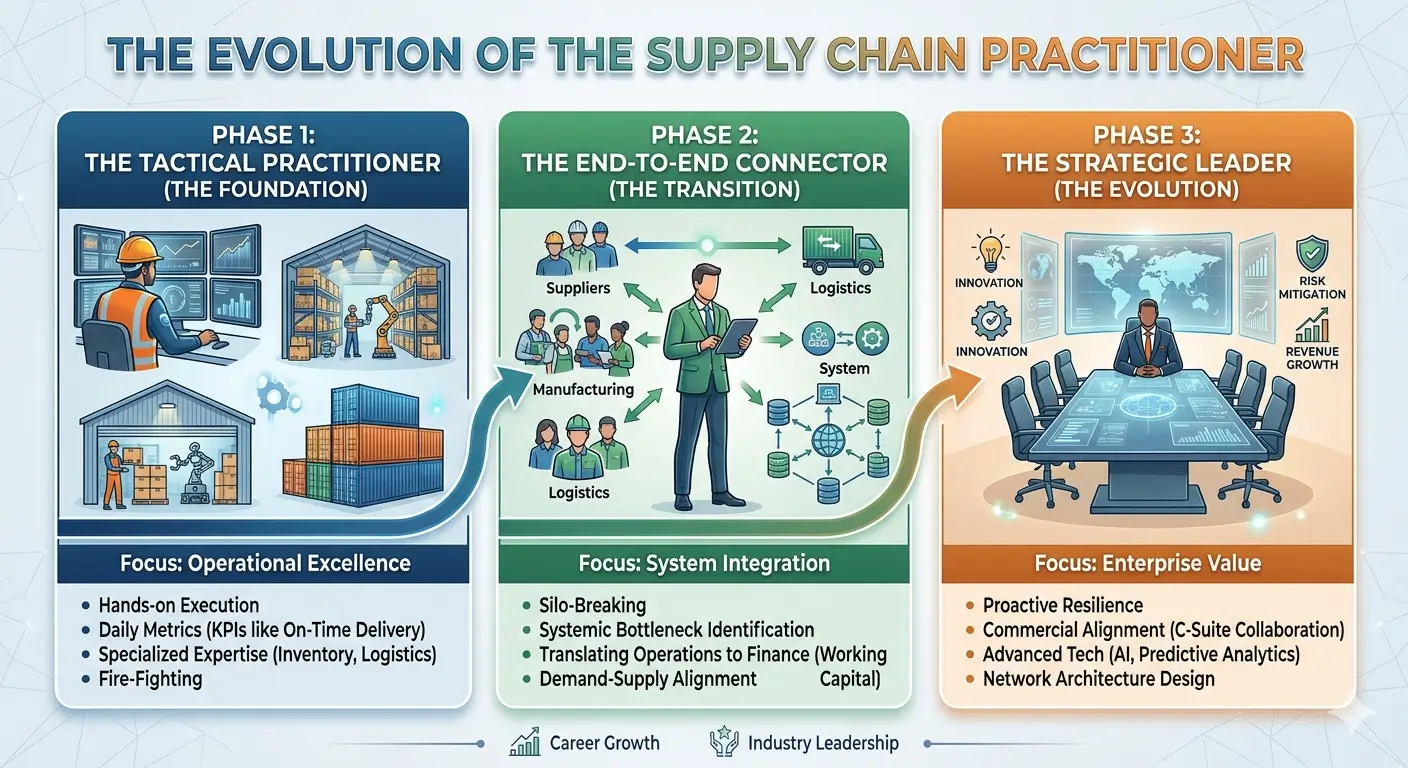
A Supply Chain Practitioner is an individual actively engaged in the hands-on execution, management, or optimization of daily supply chain operations. They are deeply embedded in the “doing” of supply chain management—such as forecasting, inventory control, procurement, warehousing, logistics, and production scheduling.
Practitioners apply practical, specialized knowledge to manage the tangible flow of goods, data, and finances from raw materials all the way to the end consumer. If there is an immediate problem on the warehouse floor, a bottleneck in shipping, or an unexpected inventory shortage, it is the practitioner who rolls up their sleeves to fix it.
The Core Differences: Practitioner vs. Professional
To better understand how these two roles differ let’s highlight four key features where their paths diverge:
1. Primary Focus
- Supply Chain Practitioner: Driven by Execution & Application. Their focus is entirely on the practical application of skills to solve immediate, tangible operational problems.
- Supply Chain Professional: Driven by Career & Standards. They focus on the broader career field, industry standards, ethics, and overarching business alignment.
2. Scope of View
- Supply Chain Practitioner: Operational/Tactical. They are deeply specialized in specific nodes of the supply chain—for example, acting as a chief procurement officer, vice president of supply chain, or director of inventory management.
- Supply Chain Professional: Strategic/Holistic. They look at the end-to-end ecosystem and evaluate how it integrates with other core business functions like finance, marketing, and corporate strategy.
3. Validation
- Supply Chain Practitioner: Validated by on-the-ground experience, functional expertise, and the successful execution of daily metrics (KPIs).
- Supply Chain Professional: Often validated by formal credentials, such as APICS/ASCM certifications (like CSCP or CPIM), advanced degrees, and industry leadership.
4. Mindset
- Supply Chain Practitioner: Thinks, “How do we optimize this specific process right now to meet demand?”
- Supply Chain Professional: Thinks, “How does our supply chain strategy drive long-term enterprise value and competitive advantage?”
The Ultimate Nuance: You Can Be Both
While it’s easy to look at these descriptions and see them as two distinct career paths there is a vital nuance: you can be both.
In fact, many high-level supply chain leaders are professional practitioners. They possess the formal strategic credentials and holistic vision of a professional, but they still retain the tactical ability to roll up their sleeves and design everyday operations.
Final Thoughts
Neither role is superior to the other; rather, they are complementary pieces of a successful supply chain architecture. A company cannot survive without the execution-focused, day-to-day grit of its practitioners. Likewise, it cannot scale or remain competitive without the long-term, big-picture strategy of its professionals. Where do you see yourself on this spectrum? Are you looking to master a specific node, or are you preparing to steer the entire end-to-end strategy? Recognizing where your strengths lie is the first step toward building a truly resilient supply chain career.