When a supply chain transformation underperforms, executive post-mortems usually point fingers at the tech stack. The software implementation took too long, the integration was buggy, or the system lacked the advanced functionality promised during vendor demos.
However, in asset-intensive and highly complex industrial environments, the truth is far simpler: Supply chain transformation is rarely limited by technology.
Technology is merely an enabler. Transformations fall short because the target operating model, leadership behaviors, and talent systems fail to evolve in step with business growth and increasing operational complexity.
Deploying an enterprise-grade ERP, advanced planning tool, or digital procurement suite onto an outdated operating model only accelerates legacy inefficiencies. To unlock true, quantifiable value, supply chain leaders must align their people, processes, and governance alongside digital initiatives.
The Trap of “Automating the Chaos”
In many growing industrial organizations, operating models develop organically rather than by design. Processes are built around legacy tools, localized workarounds, system customizations, and individual “heroes” who know how to navigate internal red tape to get critical spares to the field.
When software is introduced into this environment without structural realignment, organizations fall into the trap of “automating the chaos.”
A modern digital platform requires clear decision rights, standardized workflows, and clean data governance. If your organizational structure remains siloed—where procurement buys for price, operations manages for uptime, and finance manages for cash flow without unified incentives—no software platform in the world will reconcile those competing priorities.
3 Core Pillars for Future-Proofing Your Supply Chain
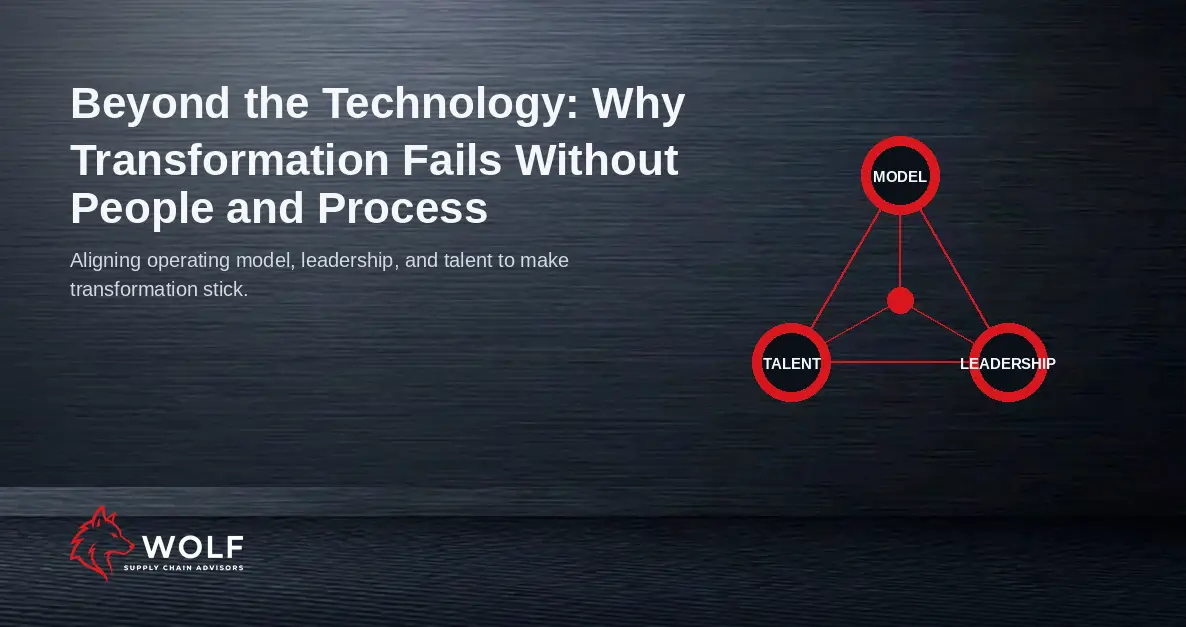
To ensure your transformation delivers measurable, permanent ROI, leadership must proactively align three critical non-technological pillars:
1. Evolving the Operating Model
Your operating model defines how work gets done, where decisions are made, and how value flows across the enterprise. As an organization scales, localized decision-making often leads to spend leakage, redundant inventory, and fragmented supplier management.
- Define Clear Governance Rhythms: Establish cross-functional operational cadences (e.g., Sales & Operations Planning, Supplier Relationship Management reviews) with explicit ownership and SLAs.
- Centralize Governance, Decentralize Execution: Center strategic sourcing, catalog control, and data standards at the enterprise level, while keeping tactical execution nimble close to operations.
- Design for Complexity: Tailor your workflows to asset-intensive realities—ensuring turnaround planning, emergency MRO purchasing, and critical spares management have dedicated, structured processes rather than one-size-fits-all rules.
2. Shifting Leadership Behaviors
Transformation requires leaders to transition from reactive tactical managers (“firefighters“) to strategic architects of value.
- Shift from Heroics to Systemic Discipline: In many industrial operations, leaders are rewarded for short-term heroics—rushing an emergency delivery or bypassing process to solve a bottleneck. True leadership transformation shifts focus on root-cause elimination, process adherence, and long-term capability building.
- Break Down Functional Silos: Executive leaders must actively align incentives across functions. Procurement shouldn’t be judged solely on purchase price variance (PPV) if it drives up total cost of ownership (TCO) or MRO inventory carrying costs for operations.
3. Upgrading Talent Systems & Capability
A modernized supply chain requires a workforce equipped with strategic capabilities, analytical literacy, and category expertise.
- Upskill from Order Takers to Category Managers: Move procurement personnel away from transactional PO processing and toward strategic category management, contract compliance, and active supplier performance tracking.
- Institute Data Governance Ownership: Train frontline personnel to understand why catalog master data, item standardization, and inventory accuracy matter. Technology relies on clean inputs; talent systems must reinforce data hygiene as a core job competency.
Measuring Transformation: Anchoring in Sustainable Results
A successful transformation isn’t measured by go-live dates or software adoption rates. It is measured by sustained operational and financial performance:
- Working Capital Optimization: Right-sizing safety stocks and MRO inventory to release capital while maintaining or improving plant availability.
- Leakage Reduction: Capturing realized savings by eliminating maverick spend and enforcing contract compliance.
- Process Velocity: Compressing cycle times for requisitions, purchase orders, and turnaround staging through frictionless, governance-backed workflows.
Building an operating model that evolves alongside your technology guarantees that when the management consultants leave or the software implementation concludes, the capabilities, discipline, and business outcomes remain permanently.
How Is Your Operating Model Performing?
Before embarking on your next technology initiative or supply chain overhaul, take a step back to evaluate your underlying operating model, talent capabilities, and governance structures.
At Wolf Supply Chain Advisors, we specialize in helping asset-intensive organizations bridge the gap between strategy and ground-level execution—delivering practical, hands-on transformations built to last.
Schedule a Supply Chain Assessment to evaluate your operational maturity and unlock sustainable value.