The question no AI demo answers
Every few weeks another supply chain AI platform promises to transform how organizations plan, buy, and stock. The forecasts are sharper and the dashboards are cleaner. Yet in the organizations I walk into, the same expedites, stockouts and surplus are still there.
After more than 35 years leading supply chains for offshore drillers, distributors, and industrial operators, I’ve reached a simple conclusion. Technology produces information. People turn information into outcomes, and only when they have clear authority, reliable data, and a disciplined process.
That distinction matters right now. Boardrooms are approving AI budgets faster than operations teams can define which decisions those tools are meant to improve. The question no demo answers is the one that decides the return: who will act on this, and how?
A forecast is not a decision
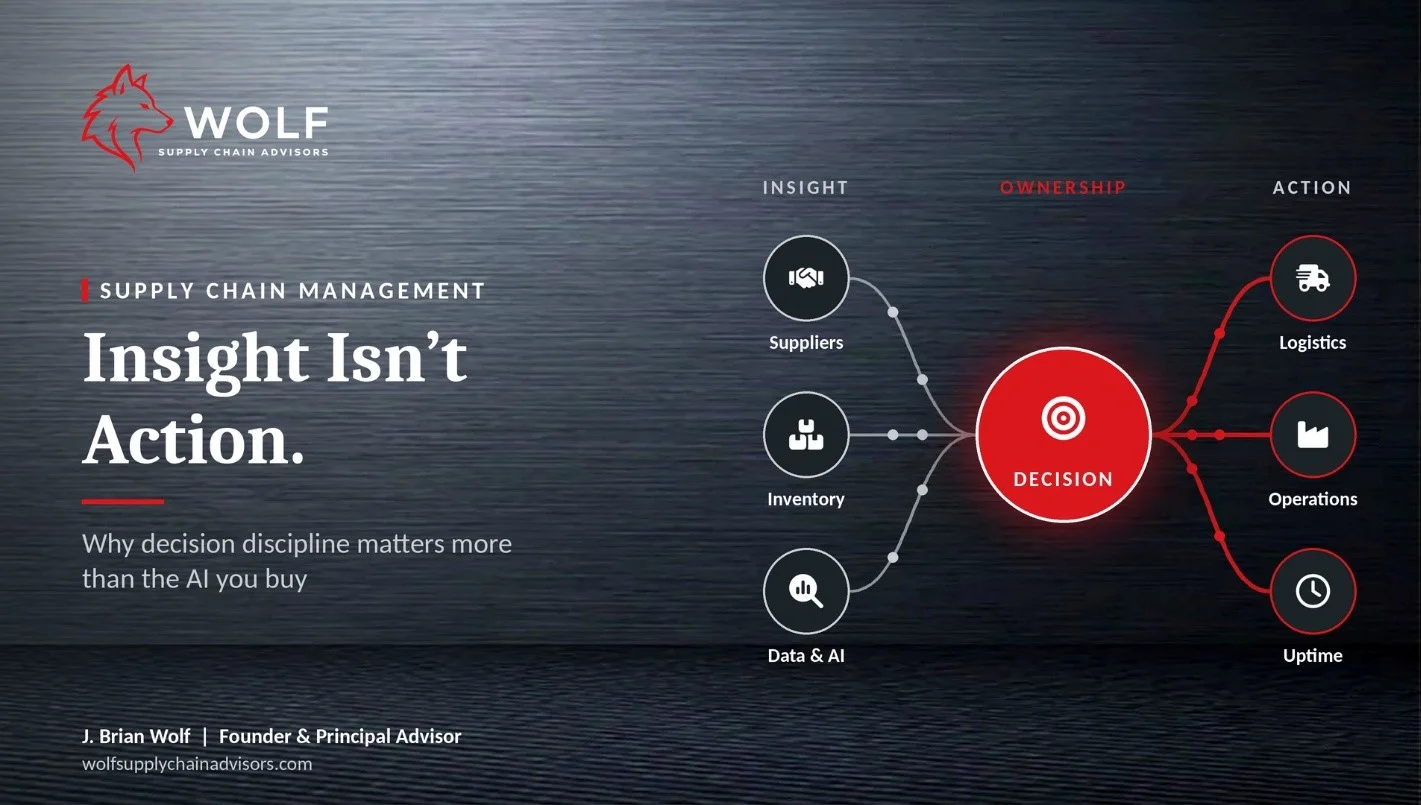
AI is exceptionally good at producing three things: a signal, a prediction, and a recommendation. None of those is a decision. A decision is a commitment of money, inventory, or capacity, made by someone accountable for the outcome.
Think about a typical exception. The system flags that a supplier’s lead time on a critical valve has stretched from 12 weeks to 20. That is insight. Someone still must decide whether to pull stock from another location, approve a premium for expedited manufacture, qualify an alternate source, or accept the risk. Then someone must execute it.
When I wrote “Beyond the Technology: Why Transformation Fails without People and Process”, the point was that software rarely fails on its own. It fails because the organization never decided how the software’s output would be used. AI is the same story, told faster.
Why the stakes are higher in asset-intensive industries
In retail, a bad AI-driven decision usually costs margin. On a drilling rig, at a refinery or in a utility substation, it can cost uptime, and uptime is the whole business model.
MRO supply chains behave differently from finished-goods supply chains. Demand is lumpy and intermittent. A part may sit for three years and then be the only thing standing between an asset that costs six figures a day when idle and a return to operation. Many of the most important items have almost no consumption history for a model to learn from.
That is exactly where algorithms are weakest and judgment is most valuable. A model that sees zero movement on an insurance spare will tell you to cut it. A practitioner who has lived through an unplanned outage knows why it is on the shelf. The decision about criticality, risk tolerance and stocking policy must be owned by people who understand the equipment and the consequences.
Decision rights come before algorithms
Before any AI tool goes live, leadership should be able to answer a simple question for each major decision: who owns it, and what are they allowed to do without escalation?
In most organizations I walk into, the honest answer is “it depends who is on shift.” Reorder points get overridden informally. Expedites are approved by whoever shouts loudest. Supplier selection drifts toward the familiar name rather than the contracted one. That is the firefighting culture I described in “Beyond the Heroics: Why Supply Chains Must Shift from Firefighting to Deliberate Planning.”
AI dropped into that environment does not create discipline. It accelerates whatever habits already exist. A useful way to frame it is three tiers of decisions:
- Automate: routine, rule-based calls with low consequences, such as replenishing high-volume consumables within approved min/max levels and contracted pricing.
- Recommendation: AI proposes, a named person approves, such as expedites, alternate-source buys or changes to stocking policy.
- Human-led: AI informs, people decide, such as critical spares strategy, supplier consolidation, and contract awards.
Writing that down, and holding people to it, is worth more than any feature on a vendor’s roadmap.
AI inherits your data, good and bad
Every AI model learns from the records you already have. If those records are wrong, the model will be confidently wrong, and at scale.
In asset-intensive operations, three data foundations decide whether AI helps or hurts:
- Material master and catalog. Duplicate part numbers, vague descriptions, and missing manufacturer data split demand across records. The model sees five slow movers instead of one fast mover.
- Inventory accuracy. If the system says two are on the shelf and the storeroom has none, every recommendation built on that number is fiction. Cycle counting and transaction discipline are not glamorous, but they are prerequisites.
- Contracts and supplier data. If blanket agreements, pricing, and preferred suppliers are not captured cleanly, AI cannot steer spend to the right place. It will optimize around leakage instead of stopping it.
This is unglamorous work, and it rarely appears in an AI sales pitch. It is also where most of the value is decided.
Where AI genuinely earns its keep
None of this is an argument against AI. Used well, it removes a great deal of low-value work and gives experienced people more time for the decisions that matter. The strongest use cases I see today are practical:
- Catalog cleansing: identifying duplicate and poorly described items far faster than manual review.
- Spend and contract visibility: reading invoices and POs to show where spend is leaking outside agreements.
- Exception triage: sorting thousands of late-order and stock alerts so planners start with the ones that threaten operations.
- Supplier risk monitoring: watching news, financial and logistics signals across a supplier base too large to track by hand.
- Document work: drafting RFQs, summarizing contract terms and comparing bids.
Notice the pattern. In each case, AI shortens the path to a decision. It does not take the decision away from the person accountable for it.
Five questions to answer before you buy the next AI tool
- Which specific decisions will this improve? Name them. “Better visibility” is not a decision.
- Who owns each of those decisions today, and will that change? If nobody can answer, fix that first.
- Is the underlying data fit for purpose? Evaluate catalog quality, inventory accuracy, and contract coverage before the pilot, not after.
- How will we know it worked? Tie success to operational and financial outcomes such as fewer expedites, lower surplus, higher on-contract spend and less downtime, not to user log-ins.
- What happens when the model is wrong? Define the override process, who reviews it and how the lessons feed back.
If those questions sound familiar, they should. They are the same questions I raised in “Does Your Company Care About Its Supply Chain?” and “Is Your Supply Chain Protecting Your Bottom Line, or Eroding It?” Technology changes. The discipline doesn’t.
AI will make good supply chain organizations better and faster. It will make undisciplined ones fail faster. The difference is not the software. It is whether leadership has defined the decisions, assigned ownership, cleaned up the data, and built the process around them.