In asset-intensive and highly complex industries, procurement operations often fall into a costly trap: the localized buying cycle.
When a company organizes its purchasing teams strictly by business units, geographic regions, or individual assets, it creates an environment of fragmented visibility. Multiple buyers end up purchasing the exact same materials, parts, or services from different vendors—or worse, from the same vendor at completely different pricing levels. This approach doesn’t just dilute your leverage; it turns your procurement department into a reactive cost center rather than a proactive value driver.
To unlock true efficiency and generate a genuine return on investment, organizations must shift from localized, reactive buying to a centralized, commodity- or category-based procurement structure.
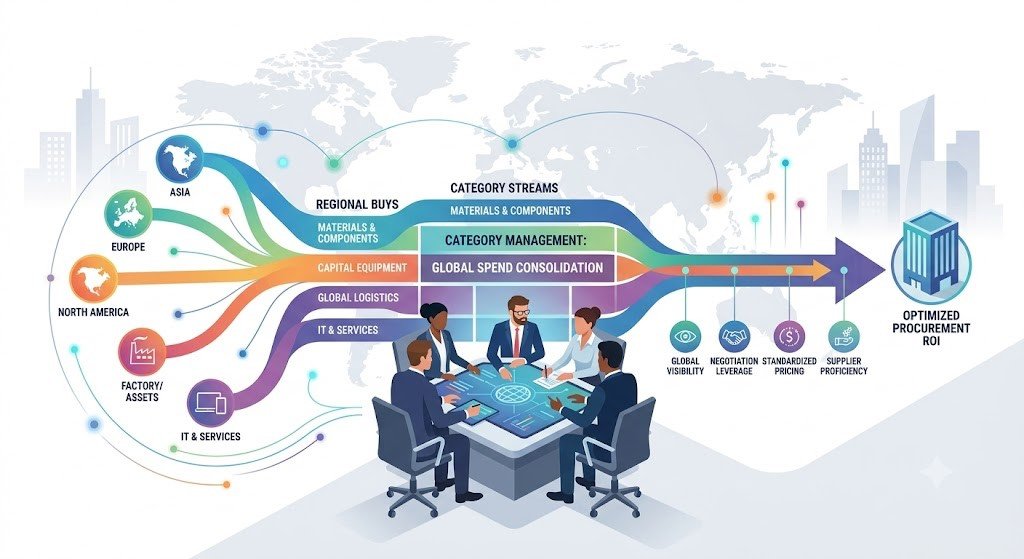
Global Visibility Eliminates Fragmented Spend
The fundamental flaw of decentralized purchasing is the lack of a single source of truth. When a procurement team is organized by category or commodity assignments, a single buyer or team is given complete oversight of a specific family of goods or services globally.
By consolidating demand, a category buyer can see all upcoming requirements across every region and project simultaneously. Instead of issuing ten separate, small purchase orders to three different vendors, the organization can aggregate its global demand. This global visibility provides two immediate advantages:
- Unmatched Negotiation Leverage: Volume aggregation allows you to approach the market with the company’s full spending power, driving down total cost of ownership (TCO) and securing preferred master service agreements.
- Contractual Standardization: It eliminates localized price discrepancies, ensuring that the price negotiated is the price paid across the entire enterprise.
The Evolution of the Buyer into a Market Expert
Perhaps the greatest long-term benefit of category-based procurement is the professional growth of the purchasing team itself. When a buyer is responsible for everything from safety gear to heavy machinery components on an ad-hoc basis, they can only ever scratch the surface of technical proficiency. They remain tactical order-processors.
Conversely, when a buyer owns a specific commodity or category, their mandate changes. They are given the time and focus required to become deep subject matter experts. Over time, a dedicated category manager builds deep proficiency in three critical areas:
1. Market Intelligence
They don’t just look at internal requisitions; they study the external market. They understand raw material indices, macroeconomic shifts, capacity constraints, and logistical hurdles that could affect lead times or pricing.
2. Supplier Dynamics
They learn who the major players are, who the innovators are, and which secondary suppliers can act as reliable backups. They handle vendor onboarding, evaluate performance metrics (like quality, response time, and on-time delivery), and conduct rigorous quarterly and annual reviews.
3. Technical & Internal Alignment
They bridge the gap between supply chain and internal stakeholders. A buyer who deeply understands their category can challenge assumptions, suggest alternative materials or commercial terms, and work directly with engineering or operations to standardize catalogs, reducing duplicate inventory.
Enforcing Strategy Through Infrastructure: The Role of ERP and Catalog Schemas
A category management strategy is only as powerful as the digital infrastructure backing it. Without the right tools, global visibility remains an elusive goal. This is where advanced Enterprise Resource Planning (ERP) systems, like SAP or Oracle, become critical. They transform strategic intent into operational reality.
An ERP system supports a commodity-based procurement model through two core mechanisms:
1. Automated Categorization and Sourcing Logic
Within systems like SAP or Oracle Fusion, spend is automatically mapped to specific material groups or United Nations Standard Products and Services Codes (UNSPSC). When an internal stakeholder enters a requisition, the ERP recognizes the commodity code and automatically routes it to the designated category buyer’s queue. Furthermore, if a global Master Service Contract or framework agreement exists for that material, the system can auto-source the purchase order to the preferred vendor at the pre-negotiated pricing level—eliminating “maverick” or off-contract spending.
2. Rigorous Catalog Schemas
The backbone of clean procurement data is a well-deployed, standardized catalog schema. By establishing strict data governance and standardizing how descriptions, part numbers, and manufacturer codes are entered into the ERP, you prevent duplicate master data.
A clean catalog schema yields massive operational benefits:
- Procurement Efficiency: Buyers spend less time cleansing vague requisitions and more time managing supplier performance.
- Inventory Optimization: It allows for precise cycle counting, loss prevention, and preservation strategies across multiple facilities because the organization finally knows exactly what it owns globally.
- Advanced Analytics: Clean data feeds seamlessly into Microsoft BI and other reporting tools, giving executive leadership a crystal-clear, real-time view of global category spend.
Ultimately, integrating category logic directly into your ERP architecture ensures that your standardized processes are repeatable, scalable, and fully auditable.
From Cost Center to ROI Generator
A procurement department should never be viewed as an administrative burden to an organization. By shifting to a commodity-focused structure, procurement transforms into a strategic asset that actively protects margins and mitigates enterprise risk.
When specialized category experts manage your global spend, you stop chasing individual transactions and start mastering the market. The result is a streamlined, center-led procurement function that ensures uninterrupted material availability, drives down total cost of ownership, and delivers undeniable value recognition straight to the bottom line.