A few weeks ago, I was talking with a group of fellow supply chain advisors, people who, between them, have walked into a multitude of companies across a wide range of industries. The conversation kept circling back to the same observation: we see unhealthy supply chain organizations everywhere. Different industries, different sizes, different symptoms on the surface. But underneath, the same pattern kept repeating.
And in almost every case, we agreed we could help. The diagnostics, the frameworks, the fixes, those aren’t the hard part. The hard part is whether the executive management team actually cares enough to engage before a crisis forces their hand. Because once management finally does get involved, getting the organization back to “healthy” almost always takes longer, and costs more, than it would have taken to simply perform a regular assessment, a checkup, along the way.
That conversation is what prompted this article.
Does Your Company Care About Its Supply Chain?
There is a question that needs to be answered before any supply chain consultant can truly help a company.
It isn’t, “What’s wrong with our supply chain?”
It isn’t, “How much inventory should we carry?”
And it isn’t even, “How can we reduce our costs?”
The first question is much more fundamental:
Does your company care about its supply chain?
That may sound like an odd question. After all, virtually every executive would say yes. Supply chain affects customer service, margins, working capital, growth, risk, and ultimately the ability to deliver on the company’s promises.
But saying you care about something and actively taking care of it are two very different things.
And there is a useful parallel in how we take care of ourselves.
How Do You Take Care of Your Health?
Think about your own approach to healthcare.
Some people get an annual physical. They monitor their blood pressure, cholesterol, weight, diet, exercise, sleep and other indicators. They try to identify potential problems before they become serious.
Others take a different approach.
They feel fine, so they assume everything is fine.
They put off the annual checkup.
They ignore the occasional warning sign.
They tell themselves they’ll exercise more next month, eat better next week, or get that lingering issue checked out “when things slow down.”
And then one day, something happens.
A minor problem becomes a major problem.
Now they are not going to the doctor for a checkup. They’re going because something hurts.
At that point, the conversation is different.
The question isn’t, “How can we stay healthy?”
It’s, “How do we fix this?”
And depending on how long the problem has been developing, getting back to good health may take considerably more time, money, and effort than it would have taken to prevent the problem in the first place.
Supply chains are remarkably similar.
Most Companies Don’t Have a Supply Chain Problem—Until They Do
For many companies, supply chain is invisible when it is working.
Customers receive their orders.
Plants have the materials they need.
Inventory is available.
Suppliers deliver.
Transportation shows up.
Working capital is within expectations.
Everything appears normal.
So, supply chain gets pushed down the priority list.
There is always something more urgent for the executive team to address: revenue growth, customers, sales, acquisitions, product launches, hiring, technology, quarterly results.
Until suddenly there isn’t.
A critical supplier misses deliveries.
Inventory levels explode.
Customer service deteriorates.
Expedites become routine.
Margins disappear.
Working capital gets trapped in inventory.
A key customer threatens to leave.
A plant shuts down because a part isn’t available.
And suddenly, supply chain is no longer happening in the background.
It is now in the emergency room.
That’s when the consultants get called.
The Emergency Room Is an Expensive Place to Manage a Supply Chain
This is where many supply chain consulting engagements begin.
There is nothing inherently wrong with bringing in outside expertise when a problem occurs. In fact, an experienced outside perspective can be incredibly valuable.
But there is a fundamental difference between treating an acute problem and maintaining a healthy supply chain.
When a company waits until the symptoms become severe, the problem is usually more complicated.
The data may be unreliable.
Processes may have evolved through years of workarounds.
Roles and responsibilities may be unclear.
Technology may be masked rather than solving problems.
Inventory policies may be disconnected from customer requirements.
Supplier relationships may have deteriorated.
People may be exhausted from constantly fighting fires.
And perhaps most importantly, the organization may have lost sight of what “good” looks like.
Just as a person who has ignored their health for years cannot necessarily become healthy with one visit to the doctor, a company cannot expect a deeply dysfunctional supply chain to be fixed overnight.
Recovery takes time.
The Executive Team Sets the Tone
This is where general management plays an enormous role.
Supply chain doesn’t exist in isolation.
The CEO, CFO, COO, commercial organization, operations, procurement, product development, and supply chain all make decisions that collectively determine how healthy the supply chain will be.
If sales continually promise customers whatever they want without considering operational realities, the supply chain feels it.
If finance relentlessly cuts inventory without understanding service requirements and variability, the supply chain feels it.
If operations optimize individual plants without considering the end-to-end network, the supply chain feels it.
If procurement selects suppliers based primarily on piece price, the supply chain feels it.
If product development introduces complexity without considering the downstream impact, the supply chain feels it.
And when executives only pay attention to supply chain when something goes wrong, the organization learns an important lesson:
Supply chain matters when supply chain is hurting.
That’s a dangerous culture to create.
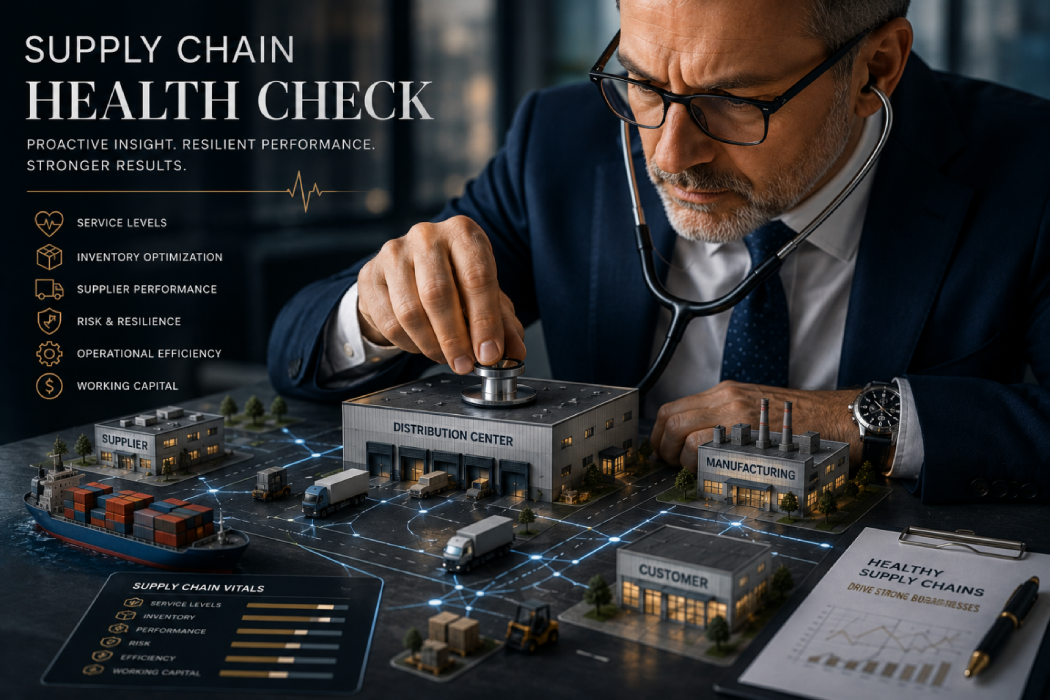
What Would a Supply Chain Physical Look Like?
Imagine if companies treat their supply chains the way a responsible person treats their health.
What if, once a year, the executive team asked:
- How healthy is our supply chain?
- Where are we most vulnerable?
- Are our inventory levels appropriate for the service we promise?
- How resilient are our suppliers?
- Where are we dependent on a single source?
- How reliable is our demand planning?
- How much variability exists in our business?
- Are our planning processes working?
- Are our systems giving people the information they need?
- Where are we routinely expediting?
- Where are we carrying inventory because we don’t trust the process?
- How much working capital is tied up because of uncertainty?
- What happens if our largest supplier fails?
- What happens if demand changes by 20%?
- Can our supply chain support the company’s growth strategy?
None of these questions necessarily indicate that something is wrong.
That’s the point.
You don’t get an annual physical because you know you’re sick. You get one because you want to know whether you’re healthy.
Supply chain should be no different.
Symptoms Matter
Of course, there are warning signs.
Just as high blood pressure, fatigue, recurring pain, or abnormal test results can signal an underlying health issue, supply chains have symptoms of their own.
Expediting.
Excess inventory.
Stockouts.
Poor forecast accuracy.
Low supplier performance.
Long lead times.
Constant schedule changes.
High freight costs.
Declining customer service.
Too many planners working too many hours.
Too many spreadsheets.
Too many exceptions.
Too many meetings about problems that seem to repeat themselves.
These aren’t necessarily the root causes.
They are symptoms.
And treating the symptom without understanding the underlying condition can create another cycle of temporary relief followed by another crisis.
The goal shouldn’t simply be to make the symptoms disappear.
The goal should be to understand why the symptoms exist.
Prevention Is a Management Strategy
The irony is that supply chain often receives the least strategic attention when things are going well.
When service levels are strong and inventory is under control, nobody calls an emergency meeting to celebrate the absence of a crisis.
But that doesn’t mean nothing is happening.
It means the system is working.
Healthy supply chains don’t happen by accident.
They are designed, monitored, measured, challenged and continuously improved.
They have clear objectives.
They have appropriate performance indicators.
They understand risk.
They know where their vulnerabilities are.
And importantly, leadership recognizes that supply chain isn’t merely an operating function.
It is a business capability.
So, Does Your Company Care About Supply Chain?
This is the question I would encourage every executive team to ask.
Not, “Do we have supply chain people?”
Not, “Do we have an ERP system?”
Not, “Are our inventory numbers acceptable?”
And not, “Who can we call when something goes wrong?”
Instead:
Do we actively take care of the health of our supply chain?
Do we understand its current condition?
Do we regularly assess its performance and vulnerabilities?
Do we invest in prevention?
Do we recognize the early warning signs?
Do we address problems before they become emergencies?
And perhaps most importantly:
Is supply chain part of the conversation before the business makes decisions—or only after those decisions create problems?
Every supply chain consultant has a different specialty, methodology, and way of helping clients.
But before any of that matters, there is a prerequisite.
The organization has to care.
Because you can bring in the best doctor in the world, but if the patient doesn’t believe they need a checkup, there is only so much the doctor can do.
The healthiest companies don’t wait for their supply chain to hurt before they start taking care of it.
They get the checkup.
They understand the warning signs.
They address small problems before they become big ones.
And they treat supply chain health as something worth protecting, not simply something to fix when it breaks.
So, How Healthy Is Your Supply Chain?
At Wolf Supply Chain Advisors, we work with executive teams across asset intensive industries to answer exactly that question, before it becomes an emergency. A supply chain checkup isn’t about assuming something is broken. It’s about knowing where you stand, where you’re vulnerable, and what it would take to be truly resilient.
If it’s been a while since your organization had one, or if you’re not sure it ever has, let’s talk. Reach out to schedule a conversation about what a supply chain health checkup could look like for your business.